
| OS Route Map → |  |
GPX Route file → |
Date: 19 Apr 2019
Start: Dinas Mawddwy / Finish: Dolgellau.
Maps: Explorer O23 Cadair Idris & Llyn Tegid.
| Day 1 | Foel Dinas, Maesglase & Cribin Fawr | 6.3miles / 3173 feet (10.1km / 967m) |
| Day 2 | Waun-oer & Mynydd Ceiswyn | 6.7miles / 961 feet (10.8km / 292m) |

A backpack of the Dyfi group of hills, a little walked ridge traverse from Dinas Mawddwy in the east to the A487 summit pass in the west, returning to Dolgellau over the low hill country north-east of Gau Graig via the old restricted byway.
This route was a good choice for a predicted warm and sunny Easter weekend with hordes of walkers on more popular hills and some disruption on public transport in other areas. A noon start meant that we saw a mere handful of walkers on Maesglase and nobody else at all thereafter.
The return to Dolgellau from the A470 via the old byway route is a new line for us, quite straightforward until it enters its highest reaches at the 380m contour when it becomes confusing in a hummocky landscape of walls and stunted trees with no waymarks, much like similar sections of the Mawddach Way that we walked recently. After weeks with little rain the occasional normally squelchy sections of the route were very dry for April.
The walk begins with a fine waymarked woodland path that leaves the A470 and climbs steadily to the old Foeldinas quarries, an ascent that soon made us realise just how hot it was and concentrated our minds on water supplies. At the old quarry buildings we left the footpath line and turned north-west up the ravine of the Nant Minllyn that falls through spoil heaps, small quarry tunnels and a gaping chasm, a rather rough but interesting ascent that emerges on open moorland.
We picked up a vague quadbike track that continues near the Nant Minllyn with a view over to Llyn Foeldinas, leaving a trackless final ascent to Foel Dinas and the first view to Maesglase ahead.


An intermittent path descends the south-west ridge to Bwlch Siglen, a line that seemed far rougher than we remember it, sometimes barely visible through the dense bilberry that was occasionally waist-deep. The loss of height seemed a lot greater too as we arrived at the bwlch and began the ascent around the splendid cwm of Maesglase and reached the waterfall at its centre, not spectacular today though after a dry spell.
The path hugs the rim of the cwm, giving great though rather thick views, to arrive at Maen Du, the old mountain summit before it was relocated to a slightly higher point to the west.


The unusually dry ridge follows fence lines westwards with barely a squelch today to traverse a small hump at spot-height 587 where a raven was perched on the fence with its beak agape, perfectly still, silent and unperturbed by our presence just a couple of metres away. Looking back later it was still there.
The next summit was Craig Portas that usually gives a superb vista of Cwm Cerist but the slopes were quite dull in shadow this late afternoon, however there was a bright view back along the ridge towards Maesglase.
Continuing north-westwards along the fence to the next bwlch, the final ascent is a gradual one to Cribin Fawr where we made an excellent pitch.


A bright thinly veiled moon cast its glow on the tent most of the night and the pre-dawn sky promised another fine day, greeted by the song of the skylark and, for the first time in a long while, the guttural cackling of the grouse.
The scene was set for a grand early promenade along the ridge, a short steep pull up to the trig point of Waun-oer and an easy walk over the minor rise of Mynydd Ceiswyn with fine views of the Cadair Idris mountains and a hazy prospect to the Tarrens.


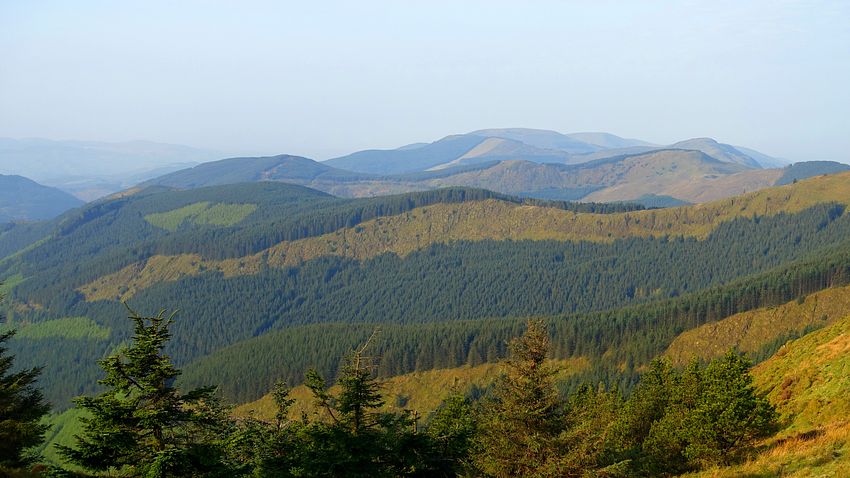
At the next bwlch we descended westwards via the footpath, crossing a surfaced cycle route to a waymarked path down to the A487 with a good view of the head of Cwm Rhwyddfor flanked by Gau Graig and the crags of Craig y Llam.
Opposite the ladder stile onto the A487, a good off-road path has been established through the young trees of the quarry grounds that links with the start of the restricted byway track heading northwards. Waymarks guide the route across a stream and up north-westwards through the fields. The way is scrappy but clear enough until it reaches the highest ground with plenty of irregular walls, scattered small trees and no waymarks. This is great wild country but some care is needed to sort out the descent to the road head at Bwlch-coch.


The narrow lane descends directly to Dolgellau, following the Afon Arran in its lower reaches with pleasing views of the little falls through the trees. In hindsight we could have improved the final stretch from Fron-goch by leaving the lane to follow the riverside footpath west to Pandy and the footpath north to the outskirts.
We arrived in the hot and bustling town just in time to pick up drinks and catch a bus back.
