
| OS Route Map → |  |
GPX Route file → |
Date: 30 Aug 2018
Start: Pooley Bridge. Finish: Windermere station.
Maps: Explorer OL5 & OL7: English Lakes NE & SE.
| Day 1 | Loadpot Hill & High Street | 10.5miles / 2973 feet (16.9km / 906m) |
| Day 2 | Ill Bell ridge & Dubbs Reservoir | 8.6miles / 1016 feet (13.8km / 309m) |

A linear 2-day north-south hike of the far eastern fells of the Lake District, joining the line of the Roman road at Moor Divock near Pooley Bridge as far as High Street and traversing the Ill Bell ridge to the Garburn Pass and Dubbs Reservoir.
We have walked various circuits of all these fells before, but our new public transport regime allowed an obvious natural traverse from Pooley Bridge to Windermere station.
The first day was overcast and grey for the very long and gradual approach to Loadpot Hill and the northernmost summits, but the tops were clear with interest in the dramatic cloud patterns. The second day was in glorious sunshine for the more mountainous scenery of the Ill Bell ridge, surprisingly cold for late August at dawn but becoming very warm by afternoon.
We took the lane south-eastwards from Pooley Bridge to the boundary of access land where it becomes a track ascending onto the expanse of Moor Divock, an area with many paths and peppered with historical sites. Turning right at the first main intersection, another track led us to the quite busy area of The Cockpit stone circle where a group of people were seated on the stones. Turning right again on another major track to seek the course of the Roman road, we were anticipating a prominent path but it's actually the weakest path we saw in this area and easily missed, just a fairly worn grassy line departing the track and gradually ascending the moorland south-westwards.
A long time later we arrived at the trig point on Loadpot Hill giving a grey cloudscape and dark mountain view westwards and a somewhat brighter prospect eastwards to Cross Fell. Across the next dip is the undistinguished top of Wether Hill to the left of the path.
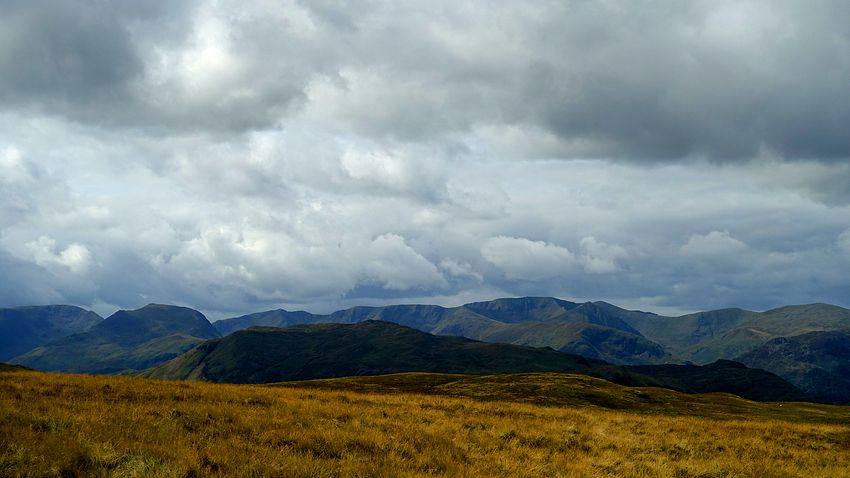

Descending from Wether Hill, we took a left fork in the path that descends to Keasgill Head and climbs to join the ridge wall. A while later there is a gate and waymark on the west side of the wall that we don't remember from years ago leading onto a path over the slight rise of Raven Howe. This later returns to the east side and climbs the slopes of High Raise but bypasses the summit, the first rocky one encountered. The sun was breaking through intermittently to brighten the mountain scene.
At the next col the rightmost of several onward lines climbs quickly to Rampsgill Head with its fine view of the valley to the north. Next is the excellent path around the rim of Twopenny Crag to the Straits of Riggindale and an easy ascent alongside the wall to the trig point on High Street.


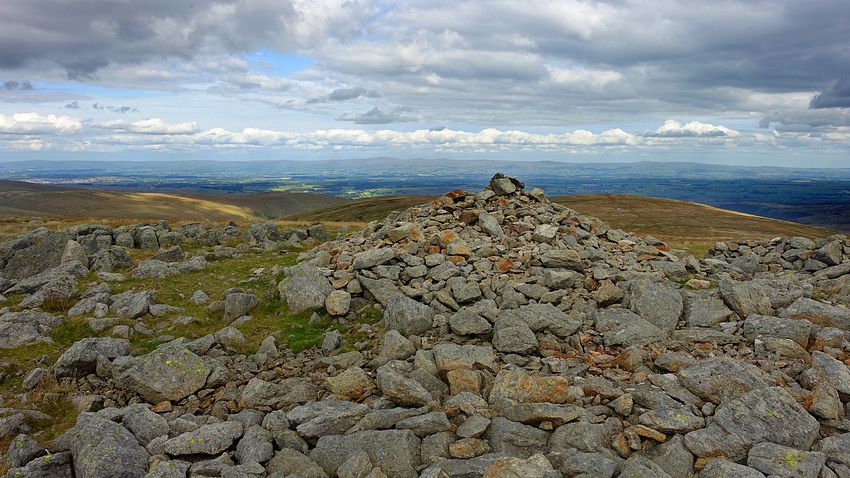


Just one small family group remained at the usually busy trig point on High Street. We have camped here before but in mid winter, this time we continued down to the broad grassy area above Gavel Crag to distance ourselves from the paths and made a good pitch with a view of the onward ridge and Windermere to the south. To the east was Harter Fell and closer at hand the columnar cairn of Thornthwaite Crag.


The extensive cloud cover disappeared overnight to bring a clear dawn with quite a chill in the air and a cold breeze. The early low-angled light can bring curious colour effects, at first enhancing the red and giving an orangey glow to the view of the Ill bell ridge from the pitch and later imparting a strong yellowish hue to the slopes. Another classic backpacking morning.
We set off on the excellent and all-too-short path around the edge of the steep slope to join the main highway heading for the ridge with a view of Kentmere reservoir below.


From the summit of Yoke we descended east along side a fence to visit Rainsborrow Tarn, a pool perched on the edge of the final drop to the valley that we last saw 14 years ago covered in ice. The traverse back to the ridge path alongside the broken wall is more scrappy and awkward than we remember but rejoins the main path at a gate.
At the Garburn Pass we picked up the track of the Garburn Road and forked left at the bifurcation onto Dubbs Road. At the Garburn Road disused quarry spoil heaps, now much softened by colonising plants, the sunlight was glinting brightly through the branches of a fine old tree and we used this as an experiment for trying some camera settings: we quite like the result, another pleasing photo acquired by chance.


The Dubbs track reaches the road at Moor Howe where we picked up the lane heading south to the main road and the only technical difficulty of the walk: crossing the A591 to reach the pavement for the short walk into Windermere (seriously). Shortly before this point there was a permitted path to access Orrest Head and its famed views, in hindsight we should have taken that instead. Anyway we arrived in plenty of time to buy food and drink before our booked train.